Astrology and astronomy share a common ancestor: the human instinct to look up at the sky and find pattern, meaning, and orientation in what is there. The constellations that form the foundation of astrological tradition were named by people sitting under clear, dark skies, watching the movement of planets and stars across a horizon unobstructed by light pollution or forest canopy. They were people who understood, at an intuitive level, that time moves in cycles, that the sky is a clock, and that the rhythms visible above have some relationship to the rhythms experienced below.
The Daintree Rainforest in Far North Queensland, Australia, is a place that puts those rhythms in a different kind of perspective. It is the oldest continuously surviving tropical rainforest on earth, with some plant lineages traceable back 180 million years, before the flowering plant families that now dominate world vegetation had even evolved. The Aboriginal Kuku Yalanji people have lived within it for at least 50,000 years, developing an astronomical tradition that used the dark skies above the canopy to track seasons, navigate, and understand the cycles of the natural world. A tour through this forest is not simply a nature experience. It is a journey into a timescale that makes most human history feel recent.
Here are eight reasons it belongs on the list of anyone who thinks seriously about time, cycles, and the cosmos.
1. The Forest Is Older Than Most of Earth’s Current Plant Families
The Daintree covers approximately 1,200 square kilometres of the Cape York Peninsula in tropical North Queensland and contains plant species whose lineages predate the mass diversification of flowering plants that occurred roughly 100 million years ago. Several families represented in the Daintree, including the Austrobaileyales and Amborellales, are considered the most ancient surviving lineages of flowering plants on earth, with fossil records that trace back to the Cretaceous period.
To put this in cosmic context: when these plant lineages were already established on earth, the asteroid impact that ended the dinosaurs had not yet occurred. The continents were in different positions. The sky above them was the same sky, carrying the same stars, but the constellations had not yet been named by any human hand because no human hand yet existed. Walking through the Daintree is walking through a living record of the earth before the age of human sky-watching began, which gives the astrologer’s and astronomer’s sense of ancient pattern a different kind of grounding.
2. The Kuku Yalanji People Have One of the Oldest Astronomical Traditions on Earth
The Aboriginal peoples of Australia developed astronomical traditions that are among the oldest in human history, with evidence suggesting continuous observation and recording of celestial events spanning tens of thousands of years. The Kuku Yalanji people of the Daintree region are part of this tradition, using the positions of stars and constellations to track seasonal cycles, the behaviour of animals and plants, and the right timing for specific activities across the year.
Australian Aboriginal astronomy differs from the European and Mesopotamian traditions that underpin Western astrology in one important way: it incorporates not only the stars as points of light but the dark patches between them, the dark constellations formed by the absence of stars in the Milky Way, as significant figures. The Emu in the Sky, one of the most important figures in Aboriginal astronomical tradition, is traced through the dark dust lanes of the Milky Way rather than through the bright stars. This is a fundamentally different way of reading the sky, and it produces a different map of meaning from the same heavens that produced the Western zodiac. As our piece on what astronomy is and how it developed suggests, the history of sky-watching is considerably more diverse than any single tradition captures.
3. The Dark Skies Above the Daintree Are Among the Best in the Southern Hemisphere
The Daintree region is one of the least light-polluted areas of the Australian eastern seaboard. The nearest significant urban centre is Cairns, about 100 kilometres to the south, and the forest’s protected status has prevented the kind of resort and residential development that would introduce the lighting infrastructure that destroys dark sky quality at comparable coastal destinations. On a clear night above the Daintree, the Southern Hemisphere sky is available at a quality that is simply not accessible to most city-based astronomers and astrologers.
The Southern Hemisphere sky contains celestial objects invisible from the Northern Hemisphere: the Southern Cross and its pointer stars, the Magellanic Clouds (the two satellite galaxies of the Milky Way, visible to the naked eye as detached patches of the Milky Way), the southern celestial pole without a convenient pole star to mark it, and the full sweep of the Milky Way galactic core in summer. For Northern Hemisphere observers accustomed to the northern zodiac constellations, the Daintree sky is a rotation of the entire reference frame, and that disorientation is itself instructive about how contingent the sky-reading traditions we inherit actually are.
4. The Forest Canopy Produces Its Own Relationship With Light and Darkness
Inside the Daintree’s dense rainforest canopy, the relationship between light and darkness is unlike anything in an open or semi-open environment. At midday, the forest floor receives perhaps two percent of the light falling on the canopy above. The light that does penetrate is filtered through multiple layers of leaf surface, arriving dappled, green-shifted, and moving with the breeze in patterns that are never quite the same twice.
This relationship between overhead filtering and ground-level light has a direct parallel in astrological thinking about how planetary influences are modified by sign, house, and aspect: the original source of light is constant, but what reaches the subject has been filtered, redirected, and transformed by the layers it passes through. Sitting in the Daintree forest floor light and watching the canopy shift above is a physical experience of that principle at a different scale. The moon rising through cloud cover, its light modified and softened, is the same phenomenon. The influence of lunar phases on behaviour and atmosphere is something this forest demonstrates through its own daily light cycle in ways that are worth sitting with.
5. The Forest’s Seasonal Cycles Are Driven by Rainfall, Not Temperature
The Daintree operates on a two-season cycle: the wet season from November through April, when monsoon rainfall can exceed 4,000 millimetres, and the dry season from May through October, when the forest is still humid but rain is infrequent. This rainfall-driven seasonality produces a completely different ecological calendar from the temperature-driven four-season cycle that underlies European and Northern Hemisphere astrological tradition.
In the Daintree’s wet season, rivers flood, roads close, cassowaries move to higher ground, fruit bats congregate in lowland forest, and the amphibian chorus at night is deafening. In the dry season, the forest floor is accessible, creek crossings are manageable, and the nocturnal soundscape is dominated by insects rather than frogs. This two-phase rhythm, expansion and contraction, abundance and restraint, mirrors the cyclical patterns that astrology tracks through the movement of planets, but driven by water rather than celestial mechanics. The parallel is not accidental: all cyclical patterns in nature ultimately trace back to the same astronomical source, the earth’s orbital relationship with the sun.
6. Guided Tours Navigate the Forest’s Layers in Ways That Independent Exploration Cannot
The Daintree is not a manicured park with clear walking trails and interpretive signage at every junction. It is an active, dense, ecologically complex tropical forest where the distinction between accessible track and impenetrable vegetation can disappear within a few metres of the path. The ecosystem’s complexity, the layered canopy, the epiphyte communities, the creek systems, the wildlife that is present but not obvious to an untrained eye, requires local knowledge to navigate and interpret effectively.
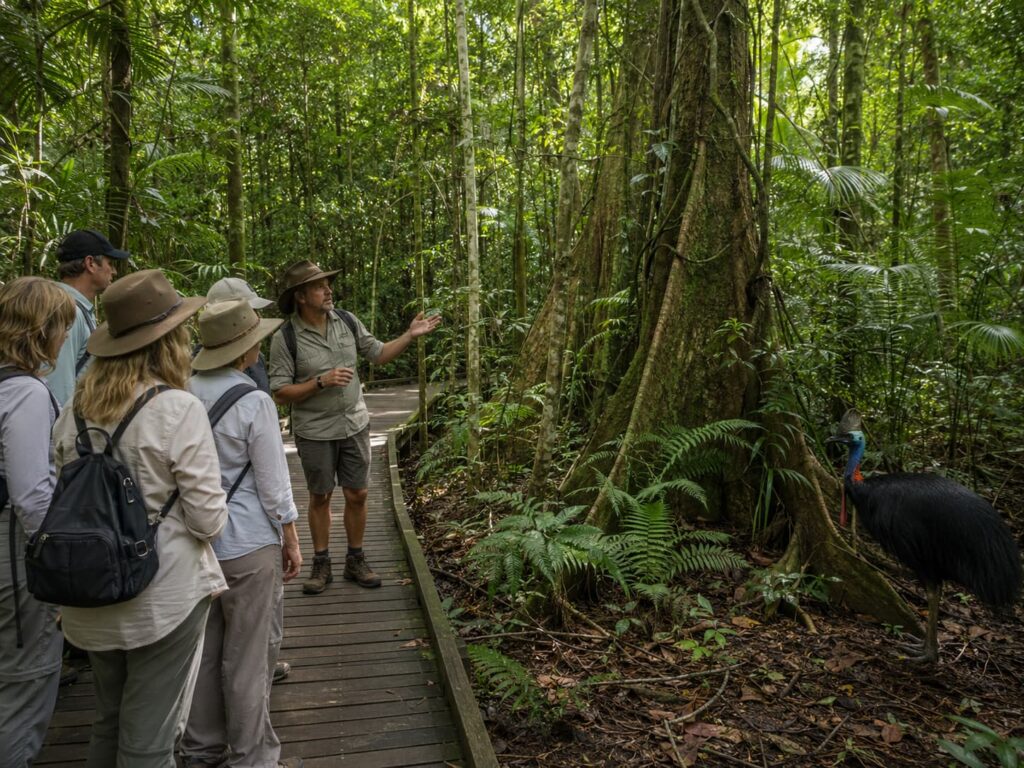
Operators like Daintree Rainforest Tours offer guided experiences through the forest’s key environments, with naturalists who can identify the ancient plant lineages, locate the cassowaries and tree kangaroos that are present but rarely seen by unguided visitors, and explain the ecological relationships that make the Daintree function as a system rather than a collection of individual species. For visitors whose interest in the forest extends to its geological age, its astronomical connections, and its indigenous cultural significance, a guide who understands these layers converts an impressive walk into a genuine education in deep time.
7. The Cassowary Is a Living Connection to the Age of Dinosaurs
The southern cassowary, which inhabits the Daintree’s lowland rainforest, is one of the most ancient bird lineages on earth. Ratites, the group that includes cassowaries, emus, ostriches, and kiwis, diverged from other bird lineages during the Cretaceous period and have retained characteristics that connect them directly to their theropod dinosaur ancestors: the casque on the cassowary’s head, the vestigial wing claws, the three-toed foot with its lethal dagger claw, and the fundamentally different musculature of a bird that never developed flight.
Standing at a respectful distance from a cassowary in the Daintree, watching it move through the forest floor vegetation, is a visceral encounter with evolutionary time that puts human history in a specific kind of perspective. The cassowary’s lineage was already old when the first human ancestors were looking up at the same sky that produced the astrological tradition. The stars the cassowary has moved beneath across its evolutionary history are the same stars, in roughly the same positions, that human observers have been mapping for meaning for the past few thousand years. The forest holds that continuity in its biology in a way that no written record can.
8. The Meeting of Reef and Rainforest Is Cosmologically Significant in Kuku Yalanji Culture
The Daintree sits at a point where two of the world’s great ecosystems meet: the tropical rainforest of the Cape York Peninsula and the Great Barrier Reef, which runs along the Queensland coast immediately offshore. This meeting of forest and reef, of the world above the waterline and the world below it, of terrestrial and marine ecology, is reflected in Kuku Yalanji cosmology as a boundary zone of particular significance, where different orders of experience and knowledge overlap.
The concept of a boundary zone where different systems meet and interact is not foreign to astrological thinking. The cusp between zodiac signs, the point where one planetary influence shades into another, the crossing of the ecliptic by a planet moving between the northern and southern celestial hemispheres: these are all boundary conditions that astrology treats as zones of particular intensity and complexity. The Daintree-reef boundary is the geographical expression of the same principle, visible in the landscape rather than in the sky, but organised by the same underlying logic of meeting, transition, and amplification at the point where different orders converge.
A Final Thought
Astrology and astronomy both ask the same fundamental question: what is our relationship to time at scales larger than a human life? The zodiac tracks cycles measured in years and decades. The great ages tracked by precession of the equinoxes measure time in thousands of years. The Daintree Rainforest answers the question in millions of years, in the plant lineages that were already ancient when the first constellations were named, in the bird that walked the forest floor before humans existed to look up at the sky above it.
Visiting the Daintree does not resolve the questions that astrology and astronomy ask. It deepens them. The sky looks different from inside a 180-million-year-old forest. The cycles feel longer. The human timescale feels more precisely what it is: a recent development in a very old story.
Go in the dry season for the access. Stay for a night to see what that Southern Hemisphere sky looks like above the canopy. Bring a star chart that covers the southern constellations. The forest will provide the context.